




Thirty-nine people got a shot. Nothing bad happened. That sounds small. It isn’t.
Researchers from the University of Cambridge and their spin-off, DIOSynVax, just wrapped up the first human trial for an experimental vaccine that might actually cover all its bases. Unlike the usual suspects – which target specific strains – this thing was built to handle multiple members of the Sarbeco coronavirus family. We’re talking SARS-CoV-2. We’re talking original SARS. And we’re talking about various bat viruses sitting out there waiting to jump over to us.
The study, published in the Journal of Infection, found the vaccine safe. No significant side effects. More importantly, it triggered immune responses against those bat viruses that have never infected humans before.
“This trial proves the safety of an entirelynew way of designing vaccines.”
That quote isn’t hyperbole. This is the first time a vaccine with an active ingredient designed entirely by computer simulations has been tested in people.
AI Meets Antigens
Here is how they did it. Researchers fed an AI system genetic data from Sarbeco coronaviruses – data pulled from global surveillance networks. The algorithm looked for the common threads, the shared features across the entire viral family, and stitched them into one “super-antigen.”
An antigen trains the immune system. A super-antigen, in this context, trains it to recognize the whole family, not just the current celebrity member.
The goal? Protection against future strains we haven’t met yet.
The tech isn’t limited to coronaviruses either. The team believes the same approach could eventually tackle Ebola or influenza. Why chase variants when you can aim for the genus?
Stop Chasing the Tail
Think about the current model. Seasonal flu shots. Updated COVID jabs. They are reactive. We wait for the virus to evolve, then we scramble to reformulate the vaccine, then we manufacture, then we distribute. It’s exhausting. And slow.
Professor Jonathan Heeney, who led the science from Cambridge, calls this shift “future proof.”
He says we have moved from a reactive stance to one that stays relevant even as viruses mutate. Traditional vaccines offer limited protection against shifting targets. He likes the current system to a dog chasing its own tail. You’re running, you’re sweating, but you never quite catch the prize.
This new method targets features shared by the entire family. New variants pop up? The immune system likely already knows what they look like.
Needles, DNA, and Next Steps
The volunteers, aged 18 to 50, received the jab at clinical research facilities in Southampton and Cambridge. The study was sponsored by University Hospital NHS Foundation Trust.
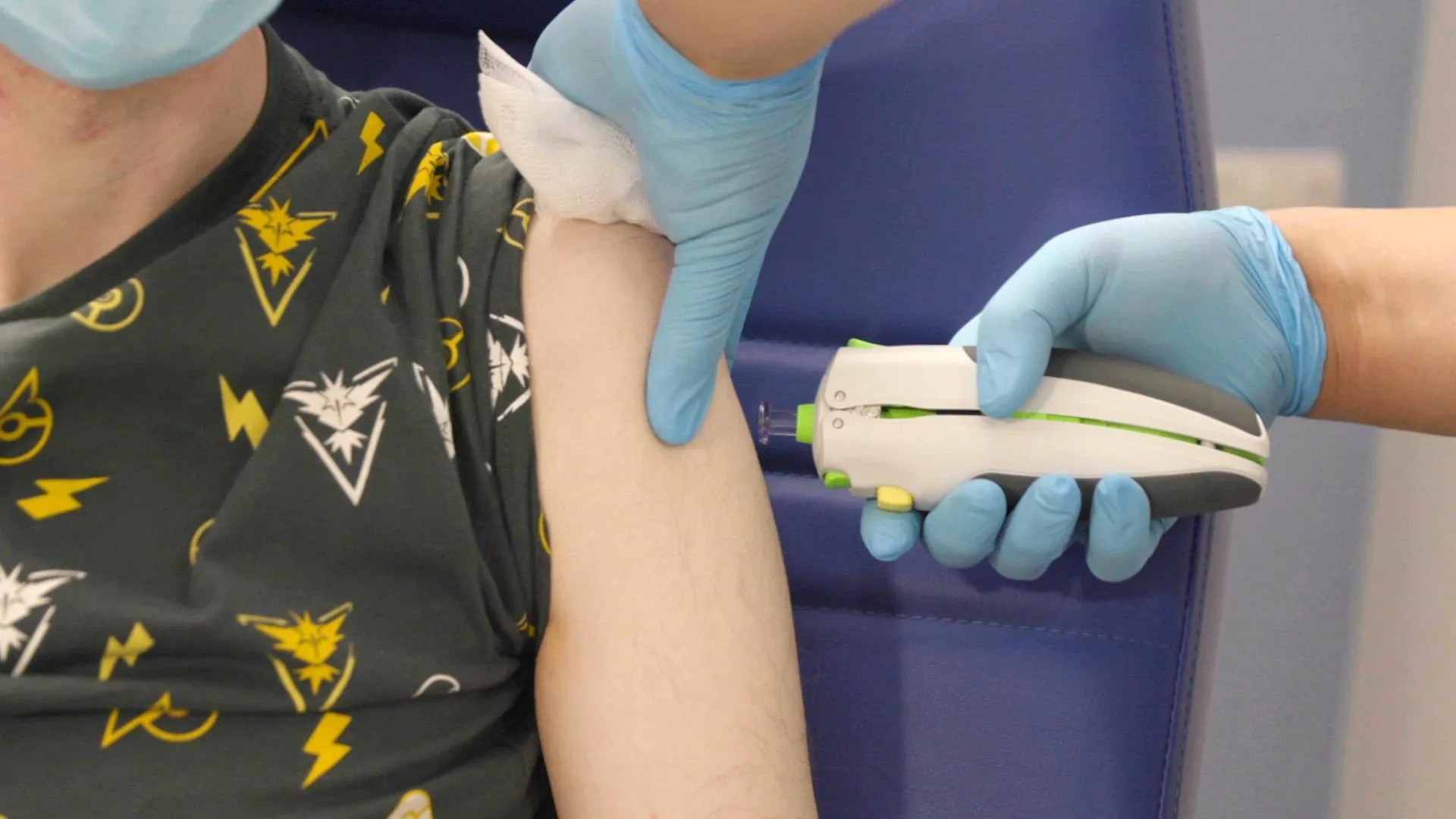
The delivery method was interesting. It’s a DNA vaccine delivered via a micro fluid jet system. No needles. Just a high-speed jet of liquid into the skin.
This matters for two reasons. One, some people hate needles. Two, in mass vaccination campaigns – think disaster zones or dense urban centers – this could be faster and easier to administer than traditional syringes.
Before humans took the shot, animal studies showed strong immune responses against multiple coronavires. Now we know it’s safe in people.
But it’s not over. A Phase 2 study is next. That will look at immune responses in a larger, more diverse group and confirm whether this wide-ranging protection actually holds up under scrutiny.
Why This Is Urgent
Viruses don’t pause for our convenience. Influenza. Ebola. Coronaviruses. They are always changing.
Professor Saul Faust of the University of Southampton put it bluntly: the current “reactive” system struggles to keep pace. By the time traditional vaccines are ready, they are often poorly matched to what is circulating.
“This new class of universal vaccines are future-proofed. They not only protect against manyvariants simultaneously, but potentially againstrelated viruses that haven’t yetemerged and spilt overto humans.”
If we get ahead of the curve, he argues, we save lives. We avoid lockdowns. We spare the economy. It sounds simple in hindsight, but doing it prospectively is the hard part.
Marian Knight, Scientific Director for NIHR Infrastructure, called it a “pivotal leap.” She noted that this only worked because of tight partnerships between the life sciences sector, the universities, and the NIHR clinical infrastructure in Cambridge and Southampton. Without that setup, moving this fast wouldn’t have been possible.
The project got its main funding from Innovate UK.
DIOSynVax – short for Digitally Immune Optimised Synthetic Vaccines – started as a Cambridge spin-out in 2017. They aren’t just doing one thing. Their pipeline includes candidates for seasonal and pandemic influenza, hemorrhagic fever viruses, other coronaviruses, and, well, this universal candidate.
Jonathan Heeney is still a professor at Cambridge and a fellow at Darwin College, but his real victory might just be breaking the cycle of reactive patching.
SARS-CoV-2 is still out there. So are other bat-borne viruses. We still can’t predict which one jumps next or when it will happen. But now we have a blueprint to be ready anyway.
Will it work? That’s for the Phase 2 trials to decide. But for the first time, we aren’t just building walls behind the invaders. We’re building a map.