


Most cancer research involving microbes focuses on gut transplants or changing what’s already there. This team took a different, much bolder approach.
They went hunting. Not in a hospital lab. In the intestines of wild animals in Japan. Japanese tree frogs. Japanese fire-bellied newts. Japanese grass lizards. They pulled out 45 distinct bacterial strains and grew them up. Then they injected them directly into the veins of mice with colorectal cancer.
Only one bacterium survived the gauntlet.
Ewingella americana.
And it didn’t just survive. It wiped out the tumors.
A 100% Hit Rate
One injection. That’s it. The study found a 100% Complete Response rate in the mouse model. Every tumor vanished.
Think about how many cancer drugs struggle to hit that mark even after multiple treatments.
E. americana beat standard care head-on. It outperformed immune checkpoint inhibitors (anti-PDL1). It outperformed liposomal doxorubicin, a standard chemo drug. The results were stark. But before we order the amphibian blood, the researchers are careful. This is a proof of concept in mice. Not humans yet. But the signal is strong enough to ignore.
How It Actually Works
The bacterium uses a two-pronged attack. It’s brutal efficiency.
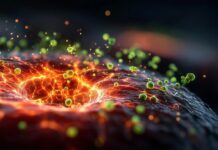
First, it exploits the tumor’s own weakness. Cancer tumors are often starved of oxygen in their cores. E. americana is a facultative anaerobe. It loves both oxygen-rich and oxygen-poor places. So while other bacteria might die inside the hypoxic center of a tumor, E. americana throws a party there.
Its population exploded. Roughly 3,000 times its original size in 24 hours. That massive bacterial growth physically destroyed cancer cells.
Second, it rallies the troops.
The bacterial invasion triggered a immune storm. T cells, B cells, neutrophils flocked to the tumor. They released inflammatory signals like TNF-a and IFN-gamma. These molecules essentially marked the cancer cells for death and amplified the immune system’s natural attack.
Why doesn’t this bacterium just go wild and eat the healthy liver too? That was the big question.
It doesn’t.
Precision Targeting
E. americana accumulates almost exclusively in tumors. It leaves healthy organs alone. Why?
The tumor creates a perfect trap.
- Low oxygen. As mentioned, it fuels the bacteria.
- The CD47 protein. Cancer cells produce this to tell the immune system “don’t eat me.” The bacteria use this immune-suppressed zone to thrive without interference.
- Leaky vessels. Tumor blood vessels are poorly constructed. They’re leaky. It’s easy for the bacteria swimming in the bloodstream to slip through into the tissue.
- Nutrients. Tumor metabolism provides unique fuel sources.
Normal tissues lack these specific conditions. The bacteria circulate, find the leaky, low-oxygen, immune-suppressed tumor, and colonize. Nowhere else.
It Wasn’t Toxic
Safety is usually the hardest hurdle for live bacterial therapies. People worry about sepsis.
Here, the data looked surprisingly clean. The bacteria were cleared from the blood quickly—half-life of about 1.2 hours. They became undetectable everywhere in the body within 24 hours except inside the dying tumor.
No colonization in the liver, spleen, or kidneys. Mild inflammation happened. It went away in three days. After 60 days? No chronic toxicity.
What could possibly go wrong in human trials? Probably something. But in mice, the safety profile held up.
What Comes Next
The researchers aren’t done. They want to try this on breast cancer. Pancreatic cancer. Melanoma. These are tough tumors. The biology of E. americana might apply to them too.
They also plan to tweak the delivery. Maybe inject it straight into the tumor instead of the vein. Maybe split the dose over time. Or combine it with chemo. The hope is synergy. The bacterium does its dirty work; the drugs do theirs. Together, they might break resistant cancers.
This study suggests something broader. We keep looking in our own guts or synthetic labs. But the answer might be in a lizard’s stomach. Or a frog’s.
Biodiversity isn’t just about saving species for nature’s sake. It’s a pharmacy we haven’t fully explored yet.
E. americana did what many drugs couldn’t in a single hit. Now the real work begins. Moving from the petri dish to the clinic is always the long game.